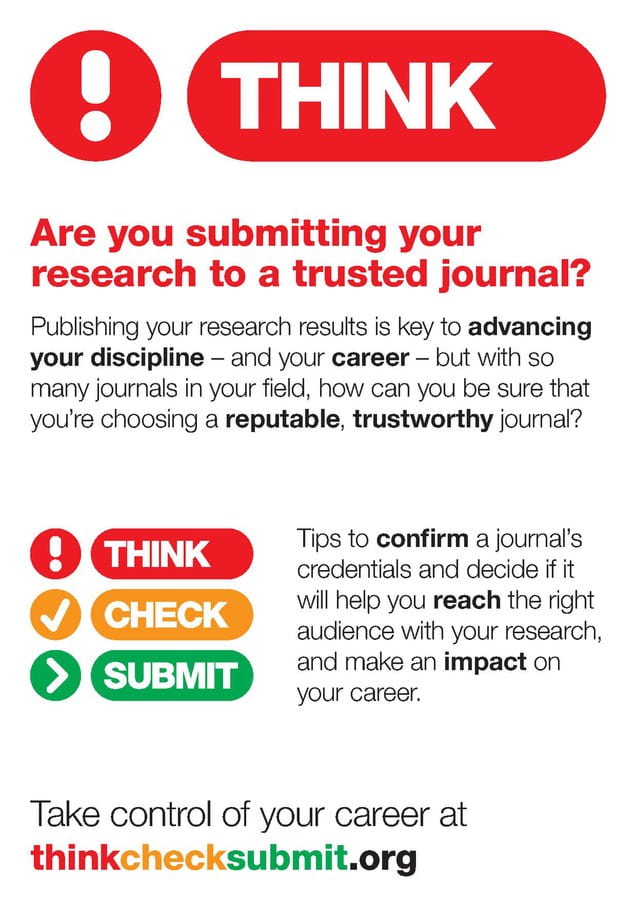
Predatory Publishers — steer clear!


(Thinkchecksubmit.org)

If you thought that academia’s ‘publish or perish’ culture couldn’t get anymore exploitative, you’d be wrong. Sadly, predatory publishers exist to make money off of academics trying to disseminate their works without providing any kind of quality checks or editorial services. The publication fee is often exorbitant, despite a total lack of input on the publisher’s end.

Jeffrey Beal, Librarian at the University of Colorado in the US, coined the term ‘predatory publishers.’ Up until 2017, he also maintained an eponymous list of predatory journals until his institution was sued by Frontiers Media. It was taken offline as a result, but you can still refer to Beal’s List here.

Beal was unequivocal in his criticism of how predatory publishing has harmed the Open Access movement, writing in 2012 that:

When e-mail first became available, it was a great innovation that made communication fast and cheap. Then came spam — and suddenly, the innovation wasn’t so great. It meant having to filter out irrelevant, deceptive and sometimes offensive messages. It still does. The same corruption of a great idea is now occurring with scholarly open-access publishing (Nature).

The email analogy is a good one, especially as this is primarily how predatory publishers target academics. Watch out for emails from publishers that are overly effusive and promise speedy publication!

Publishing in predatory journals could have several negative consequences for authors and their research:

  • Works publisher in low-quality predatory journals can be harder to find and cite. Your hard work and important findings may be disregarded by the wider scientific community. A lot of citation databases also don’t index low-quality journals, so it may be difficult for others to discover at all.
  • Loss of work. Predatory publishers ultimately have no interest in the author’s actual output and so will have no scruples about taking papers offline without warning or never actually publishing works in the first place. Bear in mind also that most legitimate publishers won’t allow you to submit a work that has been published before so you could waste a huge opportunity.
  • Diminishing scholarly integrity in the scientific community. Many predatory journals promise that works will be peer reviewed, but of course, this is not the case. As a result, works of low-quality or misinformation are brought into the scientific conversation, distracting from legitimate sources.

To avoid predatory publishers, check for basic spelling and grammar errors in their communications and website as an obvious giveaway. Take a look at their archives to see if there’s consistency in terms of research area. Also look out for clearly outlined Article Processing Charges and review processes. Note how communicable the publisher is, if you can easily get in touch with them and if they keep normal working hours for the country they state they’re based in.

These are some red flags to be mindful of, but you can use ThinkCheckSubmit.org, to check out a step-by-step guide to evaluating journal quality. You can also quickly check if a journal is featured on the Directory of Open Access Journals (DOAJ) or a member of The Committee on Publication Ethics (COPE) by having a look at their respective websites.

Lastly, if you’re ever in doubt, just get in touch with your friendly UWL Open Research team! As ever, you can email us at open.research@uwl.ac.uk. We’d be more than happy to help!

Guerilla Open Access

This week, we’re sharing a video put together for Open Access Week in late October that hasn’t had a home until now!

Check it out and make your own mind up on issues around Guerilla Open Access. In 2024, it looks like publishers are upping the ante in their fight against sites like z-library by using DMCA takedown requests so it’ll be interesting to see how things develop this year. You can read more about that here. 

Get in touch if there are any more topics you’d be interested in seeing the Open Research team cover! See our last post here. 

Podcast Recommendation: Freakonomics Radio-Why is there so much fraud in academia and can academic fraud be stopped?

You might have already encountered the popular Freakonomics book series, it was a big pop-psychology read of the 2010’s that you’d find on the ‘Smart Thinking’ shelves of Waterstones. If you haven’t kept up with the book’s prolific co-author, Stephen J. Dubner it’s worth checking out the archives of the long-running Freakonomics radio podcast series for some well-researched dispatches from the annals of behavioral psychology.

The latest episodes are of particular interest for anyone working in research, not least in the aftermath of Harvard president Claudine Gay being ousted on the basis of plagiarism charges.

The first episode in this two-parter, ‘Why is there so much fraud in Academia?’ looks into the behavioral psychology behind academic misconduct with candid interviews from exasperated academics. The second episode, ‘Can Academic Fraud be Stopped?’, focuses largely on ‘Publish or Perish’ culture with reformers of academic culture proposing new ways of challenging the existing structures set up by the $28 billion publishing industry.

Naturally, the second episode takes a brief look at Open Access as one of the proposed solutions (mostly from the publisher’s point of view). But there’s productive discussion around increasing transparency in research and other open practices that will help to change research culture for the better. Give it a listen!


New Vistas: New pastures for academic publishing

New Vistas is the University of West London’s flagship journal. It flipped from being a free-to-read and predominantly print-based journal to becoming a Gold open access publication and produced it’s first fully open access issue in April of the Spring. It is hosted by Janeway, an open source publishing platform developed by the Centre for Technology and Publishing at Birkbeck.

As a non-profit journal, the content of New Vistas is available to anyone with an internet connection and like a steadily growing number of Gold open access journals, it does not impose fees as a prerequisite for open access publication (these journals are also sometimes referred to as ‘Diamond’ or ‘Platinum’ OA journals and typically receive very modest funding from academic library budgets or learned societies). Fees known as article processing charges involve a substantial payment (either on the part of the author, an institution in receipt of government grants or a funder) to cover the nominal revenue that is lost, usually by traditional subscription-based publishers, as a result of offering barrier-free access to articles. While APCs may be considered to be “loss-making” by these major publishers, it is worth noting that these eye-watering charges are wholly unaffordable for many small institutions, nevermind our researchers, scholars and early career researchers.

The good news is that non-APC charging open access journals, like New Vistas, are on the rise and are now vastly outnumbering their fee-charging counterparts on the Directory of Open Access Journals.

So why is it that New Vistas was not considered a fully fledged Gold open access journal before now? Afterall, New Vistas content was free to read online, people within the University mostly knew where to find the content if they were looking for it and the earlier material was downloadable in PDF format.

New Vistas was established as a print journal initially, with a pdf version added later to a page on the University website. The website is pretty big so finding us was a bit hit or miss. We were not really open access – we were just posting information out there and hoping that the world took notice.

-Erik Blair, Senior Editor of New Vistas


The answer can be summarised in the figure below which highlights some of the key differences between Green open access journals (which are usually cost-free to access) and Gold open access journals (which have no price barriers and few permission barriers for reuse).


Gold open access journals for example offer open licensing, such as Creative Commons, as standard. This is a formal grant of rights and permissions giving back to the user many of the rights and permissions copyright normally reserves exclusively for the rights holder. This allows any user to redistribute, reuse or modify for any other lawful purpose, without financial, legal, or technical barriers other than those inseparable from gaining access to the internet itself. The only constraint on reproduction and distribution, and the only role for copyright in this domain, should be to give authors control over the integrity of their work and the right to be properly acknowledged and cited.

Hosting the journal on a platform such as Janeway, in contrast to a static page on the University’s website also allows the content to be more discoverable to users beyond the institution and the academy as a whole, potentially increasing opportunities to reach wider audiences and increase engagement.

The implementation of Document Object Identifiers (DOI) allows scholarly resources to be uniquely addressed, demonstrating a commitment to continued access in the future not merely in the present. The DOI system represents an important part of the digital preservation infrastructure that aims to reliably return a resource, in the event that a journal goes offline or a publisher folds.

Authors who publish in Gold open access journals also retain copyright of their work, giving them greater control over the conditions with which their work may be shared. This lies in stark contrast to traditional subscription-based journals and even some free-to-read journals where publishers typically claim copyright of the author’s work and impose restrictions on their dissemination and wider use.

Knowing about different licences and the various rights of authors and our readership has made a huge difference. Before I thought that posting information on the internet was the last step – something you did once you had the work all nice and neat. Now I see it as part of the process and authors are told about it from the very start – so that they can write with OA in mind. Our new website was designed with OA at the heart of things, from day one. This means that we are open, accessible, and useful to the academic community. It seems like, beforehand, we were working in the hope that someone would read our work – now it is out there and we are part of a whole movement that puts knowledge in the hands of readers.

-Erik Blair, Senior Editor of New Vistas